# Guide to Serverless

### **Introduction**

This comprehensive guide explains how to use YottaLabs’ **Serverless** feature to quickly and reliably deploy **Qwen3-0.6B** model as containerized services in a production environment.

***

### **1. Background**

Yotta Labs is a one-stop platform for AI application development. This Serverless feature is specifically designed for low-latency, high-concurrency inference services, supporting:

* **Auto-scaling**
* **Self-healing (Fault tolerance)**
* **Multi-GPU scheduling**

Unlike traditional static deployments, Serverless abstracts computing units (**Workers**) into stateless service instances that can be dynamically scaled.

***

### **2. Core Deployment Steps**

#### **Step 1: Preparation – API Key & Console Access**

![img](https://vs-oss.cqywc.com/prod/videoseek/snapshot/856271224265768960/856274557722427392_00002.jpg)

Before deploying, you must obtain your identity credentials:

1. Log in to the **YottaLabs Console**.
2. Navigate to **Settings → Access Keys**.
3. Generate and copy your **API Key**. This key is required for all automated operations and management interfaces.
4. Return to the main menu and click on **Serverless** to begin.

#### **Step 2: Image Configuration – Public vs. Private Registries**

![img](https://vs-oss.cqywc.com/prod/videoseek/snapshot/856271224265768960/856274557722427392_00003.jpg)

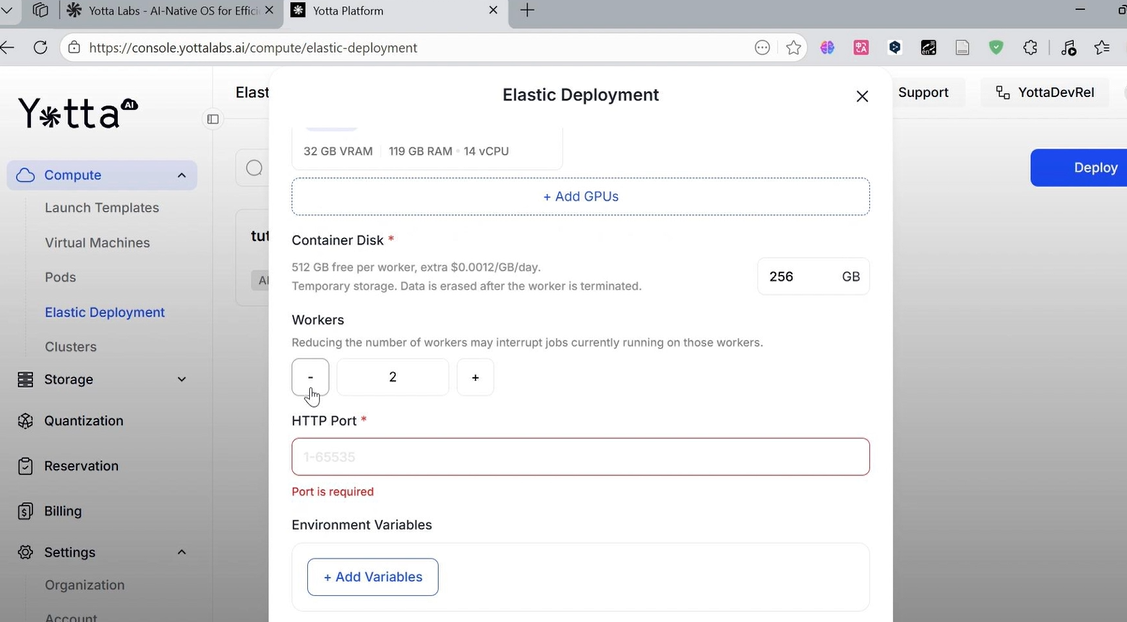
The image source is the foundation of your deployment. Yotta Labs supports two categories:

* **Docker Hub (Public):** Simply provide the full image name, e.g., `myorg/qwen-vllm:2.3.1-cu121`.
* **Other (Private):** For private registries , you must provide the registry URL and valid **Credentials**.

#### **Step 3: Service Modes & GPU Allocation**

Choose modes that matches your business logic:

<table data-header-hidden><thead><tr><th width="161"></th><th width="185.6666259765625"></th><th></th></tr></thead><tbody><tr><td><strong>SERVICE MODE</strong></td><td><strong>BEST USE CASE</strong></td><td><strong>LOGIC</strong></td></tr><tr><td><strong>ALB</strong></td><td>Web APIs / Chatbots</td><td>Automatically distributes traffic.</td></tr><tr><td><strong>Queue</strong></td><td>Batch Processing</td><td>Workers pull tasks from a queue; ideal for non-real-time tasks.</td></tr><tr><td><strong>Custom</strong></td><td>Advanced Integration</td><td>Opens raw ports for users with their own load balancers.</td></tr></tbody></table>

**For more information here, see our** [**official docs of service mode**](/products/serverless/service-mode.md)

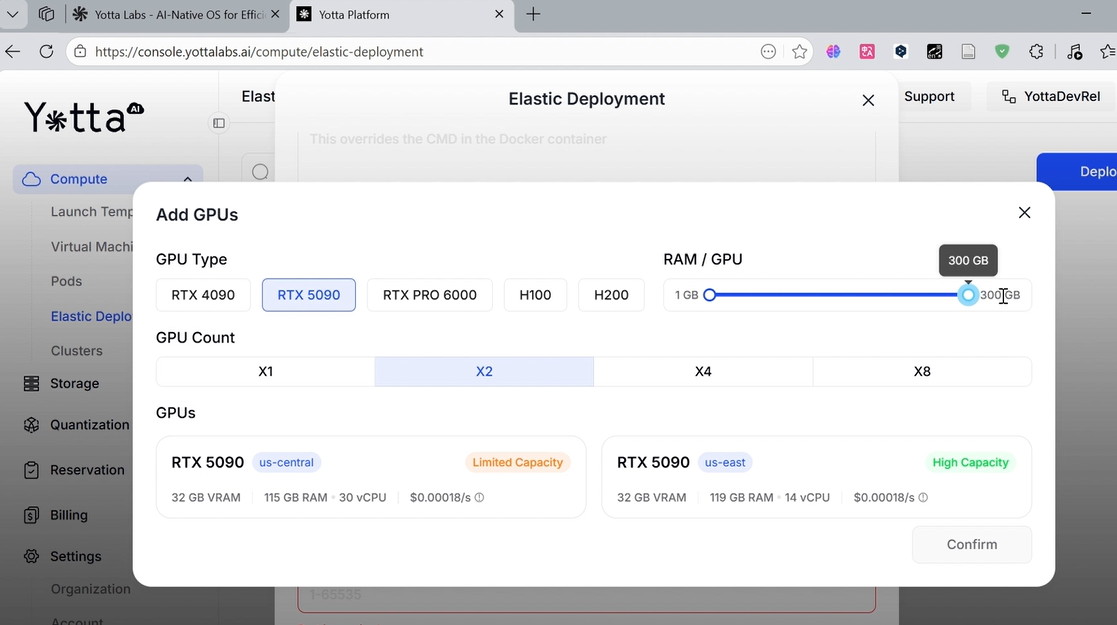
**GPU Selection:**

<figure><img src="/files/YroXPuD1S5GrNNeaqgTi" alt="" width="563"><figcaption></figcaption></figure>

You can specify the **GPU Type** (e.g. RTX 4090), **GPU Count** per worker (1–3), and **VRAM** requirements.

#### **Step 4: Elastic Mechanism – Worker Lifecycle**

<figure><img src="/files/oYZlBBtciz2qbaJWICbZ" alt="" width="563"><figcaption></figcaption></figure>

* **Declarative Scaling:** If you set the target to 2 Workers, YottaLabs ensures 2 Workers are always running.
* **Automatic Recovery:** If a Worker crashes/is terminated accidentally, the system will automatically spins up a new instance within seconds.

***

### **3. Deployment and validation**

Once the status changes to **Running**, YottaLabs generates a unique HTTPS URL. Copy the url provided in the box above.

<figure><img src="/files/fT2vutrJu2dEpal6sPT4" alt=""><figcaption></figcaption></figure>

Use a `curl` command to test the service, for example:

```
curl -X POST "https://32tkdcwyscmx.yottadeos.com/v1/chat/completions" \
-H "Content-Type: application/json" \
-H "Authorization: Bearer <YOUR_API_KEY>" \
-d '{
  "model": "Qwen/Qwen3-0.6B",
  "messages": [
    {"role": "system", "content": "You are a helpful AI assistant."},
    {"role": "user", "content": "Explain AI in simple terms."}
  ],
  "temperature": 0.7,
  "max_tokens": 512
}'
```

A successful response confirms that the VLLM inference engine, Tokenizer, and CUDA acceleration path are all functioning correctly.

<figure><img src="/files/PlfUOwrdl57KfgiTiPhX" alt=""><figcaption></figcaption></figure>


---

# Agent Instructions: Querying This Documentation

If you need additional information that is not directly available in this page, you can query the documentation dynamically by asking a question.

Perform an HTTP GET request on the current page URL with the `ask` query parameter:

```
GET https://docs.yottalabs.ai/tutorials/inference-and-serving/guide-to-serverless.md?ask=<question>
```

The question should be specific, self-contained, and written in natural language.
The response will contain a direct answer to the question and relevant excerpts and sources from the documentation.

Use this mechanism when the answer is not explicitly present in the current page, you need clarification or additional context, or you want to retrieve related documentation sections.